Posts

CLIMATE WATCH - The Greenhouse Effect

Image
What do scientists mean by the " Greenhouse Effect "? When the Sun's energy arrives at the Earth, it travels through the air. Some is reflected back to space, but some hits the Earth and warms it. The warm Earth gives off  infrared radiation  with various wavelengths.   Some of those waves can pass back out of the air to space, but some are absorbed by certain gases in the air. The gases then re-emit the energy into the air. If there are more of those gases, less heat escapes into space. An extreme case has happened on Venus. Concentrated  'greenhouse gases'  on Venus have caused the surface temperature to rise to 735  Kelvin  (462 degrees C; around 900 degrees F) Carbon dioxide levels in the atmosphere have risen quickly  since people began burning large quantities of fossil fuels. There was carbon dioxide in the air before that, at around 270 parts per million. Without any carbon dioxide, the Earth would be very cold. The temperature would be ar...
CLIMATE WATCH - The Long-Term Carbon Cycle

Image
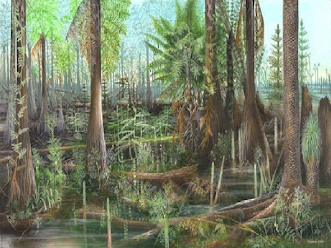
The formation of one typical coal seam took perhaps 100,000 years of photosynthesis by the first forests.  So much CO2 was removed from the air by the "coal forests" over millions of years in the Late Carboniferous that it caused an ice age (not the more recent one that most people know about) Such an intense ice age that it almost created a "Snowball Earth" around  300 million years ago: https://www.pnas.org/doi/10.1073/pnas.1712062114 Oil and gas were also produced hundreds of millions of years ago, and in their case the CO2 was taken up by tiny marine organisms in the oceans. Also over a huge amount of time. What about non-biological processes that remove CO2 from the air? These are also very slow. After the PETM warming event around 56 million years ago, it took around 20 million years for CO2 levels to fall sufficiently for glaciation to begin in Antarctica, at the Eocene-Oligocene transition. The CO2 was mainly taken up by weathering of the newly-rising Himala...

CLIMATE WATCH - CO2 and climate sensitivity

Image
The effect of increasing CO2 is often described using a concept called "climate sensitivity".  (Sometimes "equilibrium climate sensitivity" ..... ECS) Climate sensitivity basically =   "how much does the temperature rise if we double the CO2?" For example - from this paper...... "Emergent constraint on equilibrium climate sensitivity from global temperature variability" - Cox et al, 2018 "2.2-3.4C, 2.8C with 66% confidence limits" So doubling CO2 from around 270 ppm (the pre-industrial value) to around 540 ppm would raise average global temperatures by around 2.8 C deg +/-0.6 C deg We are at about 420 ppm now. At the current increase in CO2, getting to around 540 ppm by the end of century is not impossible. The IPCC have looked at all the research on climate sensitivity, and their best estimate is that doubling CO2 produces a rise in average global temperature of 3 C degrees.  This is shown in this figure from IPCC AR6 WG1:      From  ...

CLIMATE WATCH - What's Causing Global Warming?

Image
If the climate changed before humans, how can we be sure that human activities are responsible for the warming that’s happening today?1 First, we can eliminate many of the factors that can cause global climate change. 1)   The sun has been  dimming slightly for the last half-century  while the Earth heats up, so global warming cannot be blamed on the sun. 2)  Volcanoes can produce CO2, but adding up all the CO2 produced by every volcano on Earth per year gives a number less than 1% of the CO2 produced by burning fossil fuels.       3) Orbital cycles that produce changes such as ice ages are currently in the wrong phases to account for the current warming, and the changes they cause happen over very long time periods , not a century or two. Scientists have carried out studies of all the possible "natural" causes.  None can account for the current warming.  However, CO2 has been known to have a property often called "The Greenhouse Ef...

CLIMATE WATCH - The fossil fuel industry knew, decades ago

The oil industry’s pollution-control consultants advised the American Petroleum Institute in 1968 that carbon dioxide from burning fossil fuels was a serious issue. “Changes in temperature on the world-wide scale could cause major changes in the earth’s atmosphere over the next several hundred years including change in the polar ice caps.” https://insideclimatenews.org/news/13042016/climate-change-global-warming-oil-industry-radar-1960s-exxon-api-co2-fossil-fuels/ The fossil fuel industry owes huge amounts for compensation, and for lying about climate change for decades. The Exxon internal report, 1982, produced by their own scientists: https://www.documentcloud.org/documents/2805576-1982-Exxon-Memo-to-Management-About-CO2.html The key graph (it's on page 14 of the report): https://i.redd.it/ljifc828iui31.jpg Amazingly accurate for 1982, if you look at the projections for eg 2020 and beyond.

CLIMATE WATCH - Where are we headed?

Image
Where are we headed, climate-wise? It's now a choice of  difficult  outcomes or  very very difficult  (or add even more "verys" if the response is totally inadequate) Temperatures would stabilise "over a human lifetime" if CO2 levels stop rising. They don't decline quickly, but there is a very slow downward drift over a very long time. However,  all IPCC scenarios show 1.5 being overtaken at some point between around 2030 and 2040  - we've wasted too much time to do better than that - the "Denial Decades". Note that the stabilising of temperature implies EITHER all burning of fossil fuel stops, OR if some is still burned, every bit of CO2 produced is accounted for in a real process of sequestration. Stopping the rise in CO2 also begins to stabilise the water cycle, so rain etc doesn't get a lot worse (it'll be pretty bad by then) As for coastal areas - the Earth's ice masses are not even in equilibrium with the temperature we have n...

CLIMATE WATCH - 24,000 Years

Image
A quick reminder of what global warming is about. 24,000-year graph of Earth temperatures: https://cdn.arstechnica.net/wp-content/uploads/2021/11/Screen-Shot-2021-11-09-at-6.48.24-PM-980x614.png Based on this paper https://www.nature.com/articles/s41586-021-03984-4 "Globally resolved surface temperatures since the Last Glacial Maximum" -Osman et al, 2021 This comes from careful palaeoclimatological research.